
February was a relatively quiet month for markets — the S&P 500 slipped -0.9%, the Nasdaq fell -3.4%, and the Dow edged up +0.2%. Then everything changed on February 28, 2026, when the United States and Israel launched joint military strikes on Iran. Within days, the Strait of Hormuz — the narrow waterway through which approximately one-fifth of the world's daily oil supply normally flows — was effectively closed to shipping.
The questions we've been hearing from clients are understandable: How serious is this? How long might it last? What does it mean for my portfolio? This commentary focuses on what the data tells us — and what it does not — so you can think clearly about your exposure to equities, bonds, cash, and other assets in a period of genuine uncertainty.
The Strait of Hormuz Crisis: What Happened
On February 28, joint U.S.-Israeli strikes on Iran began, including strikes that resulted in the death of Iranian Supreme Leader Ali Khamenei. Iran retaliated with missile and drone attacks throughout the region. Within hours, Iran's Islamic Revolutionary Guard Corps issued warnings that any vessel attempting transit through the Strait of Hormuz would be considered a legitimate target. Tanker traffic — which normally numbers well over 100 ships per day — dropped to near zero. More than 150 vessels anchored outside the strait rather than risk attack.
The Strait of Hormuz is the world's most important oil transit chokepoint, connecting the Persian Gulf to the Arabian Sea. About 20 million barrels per day of crude oil and petroleum products normally move through it — roughly 20% of global daily supply. No alternative route can fully replace it. Saudi Arabia and the UAE have pipeline bypass capacity (the East-West Pipeline and the Fujairah route), but analysts estimate the combined deficit at approximately 12 million barrels per day — far more than any pipeline system can absorb.
In response, the International Energy Agency (IEA) coordinated the largest emergency release of oil reserves in history: 32 member nations agreed to release 400 million barrels from strategic petroleum reserves, with the U.S. contributing 172 million barrels from the Strategic Petroleum Reserve. This was a meaningful step. But as ING analysts noted, reserves can "only close up to a quarter of the supply gap" triggered by the Hormuz closure. The IEA itself called this situation "the largest supply disruption in the history of the global oil market."
Oil Price Progression Since the War Began
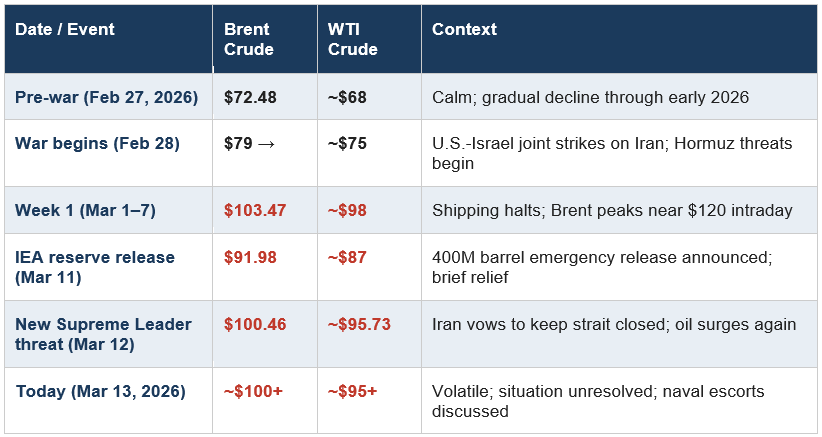
Sources: IEA Monthly Oil Market Report; CNBC Markets; AI Jazeera Energy; Wikipedia 2026 Strait of Hormuz Crisis (compiled from Reuters, AP, IEA data)
How Markets Have Responded — And What History Tells Us
The S&P 500 entered the war near a record high, and as of March 13, it is down approximately -3% from February 28. This may seem like a modest reaction to what is, by any measure, a significant geopolitical event. To put it in context: stocks fell more than 10% in the week after President Trump's 'Liberation Day' tariff announcement last April.
Part of the explanation is that markets had anticipated some form of military action against Iran for months — so the initial shock was partially priced in. But the market is beginning to grapple with a more uncomfortable question: what if the Strait stays closed for weeks, or months?
S&P 500 Performance Following Major Geopolitical Events
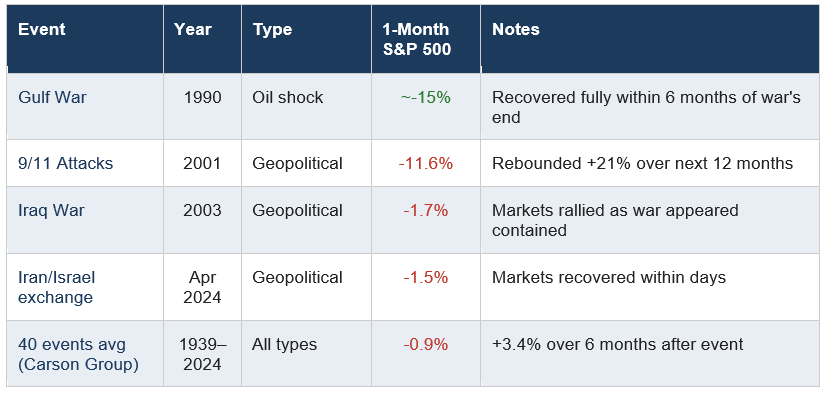
Sources: Carson Group analysis of 40 geopolitical events (1939–2024); RBC Wealth Management; Motley Fool analysis of major U.S. wars. Past performance does not guarantee future results.
The historical record shows that markets are remarkably resilient over a 6-month horizon — even in the wake of genuine crises. But there is an important caveat in the data: energy shocks are different. In the 1973 OPEC embargo and the 1990 Gulf War — the two most comparable historical cases in terms of oil supply disruption — the S&P 500 fell by double digits. Both preceded recessions. The critical variable in each case was the same one we're watching now: how long does the supply disruption last?
February Economic Data: What We Knew Before the Shock
Because economic data is collected and reported with a lag, February's numbers reflect conditions before the Strait of Hormuz crisis escalated. This matters: the data we received in early March describes an economy that was slowing, but not breaking. The Iran war introduces new variables on top of an already complex picture.
Jobs: A Weak Headline Number with Important Asterisks
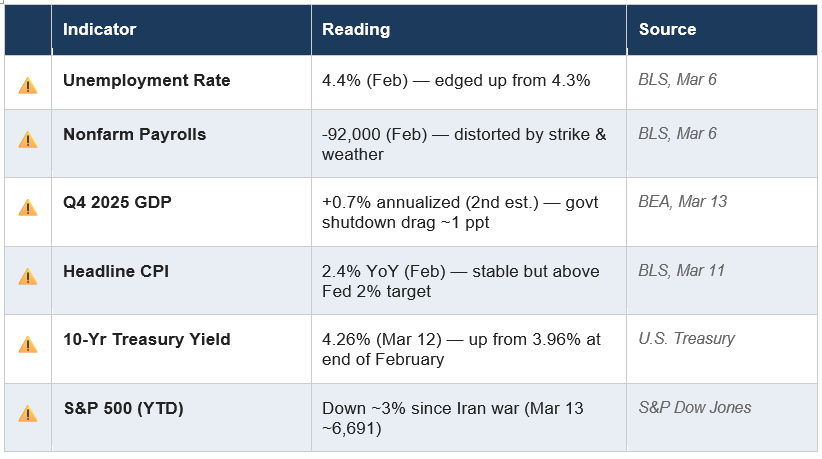
The Bureau of Labor Statistics reported that nonfarm payrolls fell by 92,000 in February — the third monthly decline in the past five months. The unemployment rate edged up to 4.4% from 4.3%. On the surface, that is a concerning report.
However, much of February's weakness came from identifiable, temporary sources:
- Kaiser Permanente nurses' strike: Removed ~28,000–30,000 health care workers from the payroll count during the survey week. The strike was resolved by February 23 — after the count was taken — meaning a one-time boost is expected in March.
- Severe cold snap: Hit many states early in the month, dragging construction down 11,000 and leisure & hospitality down 27,000.
- Federal employment: Continued its trend decline, falling another 10,000 in February, with the sector down approximately 330,000 since October 2024.
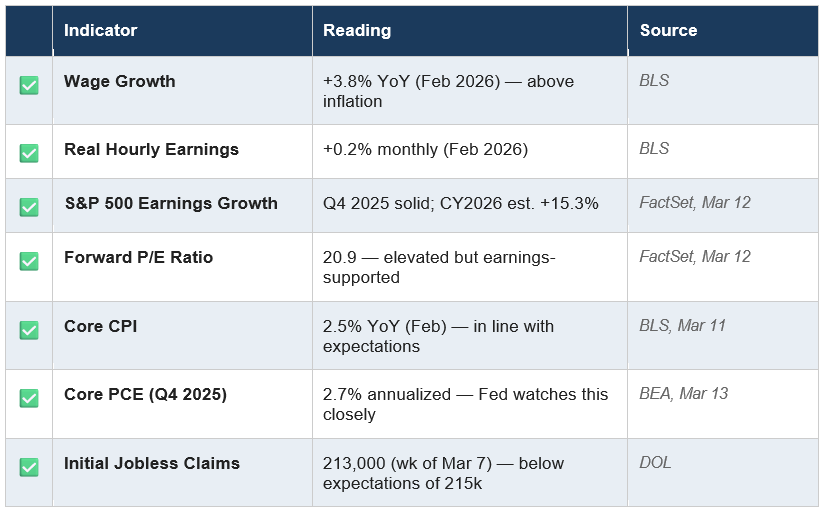
Strip out those distortions, and the underlying labor market looks somewhat better — though not without concern. Average hourly earnings rose 3.8% year-over-year and 0.4% for the month — both above expectations — which means workers who are employed are still gaining real purchasing power. Initial jobless claims for the week of March 7 came in at 213,000, below the expected 215,000, suggesting that outright layoffs remain contained.
That said, the trend of alternating positive and negative payroll prints is unusual outside of recession. White-collar payrolls have contracted for 29 consecutive months — a historically unprecedented streak — and long-term unemployment has risen to 1.9 million, up from 1.5 million a year ago. These are signals worth watching closely.
Inflation: Stable, but Pre-Shock Data
The February Consumer Price Index (CPI), released March 11, showed headline inflation holding at 2.4% year-over-year — unchanged from January and exactly in line with expectations. On a monthly basis, consumer prices rose 0.3%, with shelter (up 0.2%) accounting for most of the increase. Core CPI, which excludes food and energy, came in at 2.5% year-over-year — the lowest reading for core since March 2021.
Importantly, this report does not yet reflect the oil price surge that began February 28. Energy typically constitutes about 6.3% of the CPI basket. Gasoline prices, which had been declining, are now rising sharply as crude oil climbs. Goldman Sachs economists estimate that if Brent crude averages around $98 through March and April, U.S. headline CPI inflation could rise to 2.9% by year-end — more than a full percentage point above the Fed's 2% target. A more severe scenario with sustained $110+ oil could push inflation toward 3.3%.
The CPI data also has a subtle quirk worth noting: because the 43-day government shutdown last fall (October–November 2025) prevented federal statisticians from collecting typical data, the BLS used a carry-forward methodology for some categories. Economists at Moody's estimate the reported CPI is likely around 0.3 percentage points lower than it would otherwise be, due to this measurement quirk. This effect will wash out by spring.
GDP: A Shutdown Distortion, Not an Economic Warning Signal
The Bureau of Economic Analysis released its second estimate of Q4 2025 GDP this morning (March 13), revising growth down to 0.7% annualized — a downward revision from the advance estimate of 1.4%. For the full year 2025, real GDP grew 2.1%. On the surface, the Q4 number looks concerning. But the context is critical: the BEA estimates that the 43-day government shutdown (October–November 2025) subtracted approximately 1.0 percentage point from Q4 growth on its own. Without that self-inflicted drag, Q4 would have come in closer to 1.7%.
Private-sector demand — consumer spending and business investment — held up reasonably well. We do not view the Q4 slowdown as a meaningful signal about the underlying health of the economy. With the government fully operational again, the shutdown headwind is gone. We expect a rebound in GDP growth in Q1 and Q2 2026 as that temporary drag unwinds, assuming the Iran conflict does not materially suppress consumer and business activity. To put Q4 in broader context: Q3 2025 GDP grew at a robust 4.4% annualized and Q2 at 3.8%. The economy was not weakening before the shutdown — it was paused by it.
Corporate Earnings: A Bright Spot
With the Q4 2025 earnings season now substantially complete, S&P 500 corporate earnings have been a consistent positive. According to FactSet's Earnings Insight (published March 12), analysts project full-year 2026 earnings growth of 15.3% — what would be a third consecutive year of double-digit growth. The forward 12-month P/E ratio on the S&P 500 stands at 20.9 — above both the 5-year average of 20.0 and the 10-year average of 18.7. The market is not cheap, but valuations are supported by a strong earnings growth profile, not speculation alone.
For Q1 2026, analysts estimate earnings growth of 11.6%, which would mark the sixth consecutive quarter of double-digit earnings growth. However, those estimates were set before the Iran war began. If energy costs remain elevated and supply chain disruptions persist, downward revisions to forward guidance are likely across multiple sectors.
The Federal Reserve: Caught Between Two Problems
The Federal Reserve's next policy meeting is March 18. Traders are assigning near-100% probability that the Fed holds rates steady at the current 3.50–3.75% range — and we think that is the right call. Here is the bind: rising oil prices push inflation higher (making it harder to cut rates), while a potential economic slowdown from the energy shock could weaken the labor market (making it harder to raise rates). This combination — sluggish growth with rising prices — is what economists call stagflation, and it is the Federal Reserve's least comfortable policy environment.
The 10-year Treasury yield has risen from 3.96% at the end of February to 4.26% as of March 12 — a meaningful move that reflects bond markets pricing in higher inflation expectations. Mortgage rates, corporate borrowing costs, and the cost of credit more broadly are all influenced by this rate, so a sustained rise in the 10-year would add another layer of headwind to economic growth.
What We Are Watching
In a period like this, it is important to separate the things we know from the things we do not. Here is our honest assessment of the key variables:
The Single Most Important Variable: Duration
How long the Strait of Hormuz remains effectively closed is the number that matters most. Analysts widely agree that a short, resolved conflict (weeks) would likely result in a manageable oil shock and a typical geopolitical market recovery. A prolonged closure (months) introduces serious risk: Goldman Sachs has modeled a sustained-disruption scenario that pushes 2026 inflation to 3.3% and GDP growth to 2.1%, and raises recession odds to 25%. Oxford Economics' extreme scenario, with oil sustained above $140/barrel, would likely tip the eurozone, the UK, and Japan into recession and create an economic standstill in the U.S. As of this writing, Iran's new Supreme Leader has pledged to keep the strait closed, but naval escorts and diplomatic negotiations remain in progress.
Supply Bypass: Real, But Limited
Saudi Arabia and the UAE have begun diverting oil through pipeline bypasses — the East-West Crude Oil Pipeline and the Fujairah route — and Qatar has declared force majeure on gas contracts. These alternatives are real but face capacity limits. The combined bypass capacity covers only a portion of the normal strait throughput. The Red Sea route also carries risk from potential Houthi attacks. The IEA reserve release buys time, but as one analyst put it, it "buys us a few days." The fundamental solution remains reopening the strait.
Labor Market: Watch the Trend, Not One Month
February's -92,000 payroll print was dominated by temporary factors. But the underlying trend — alternating positive and negative monthly prints, declining job openings, rising long-term unemployment, and 29 months of white-collar job contraction — deserves attention. If the oil shock adds to economic uncertainty and companies begin to pull back on hiring more broadly, a labor market that has been described as slushy could deteriorate meaningfully.
Earnings Guidance: The First Quarter Test
Q1 2026 earnings season begins in April. This will be the first earnings cycle in which companies will speak directly to the impact of the Iran war on their cost structures, supply chains, and demand forecasts. We expect a wave of cautionary guidance revisions across energy-intensive sectors (transportation, manufacturing, chemicals, airlines). How the market responds to those revisions will be an important signal.
Our View: We Remain Bullish
We want to be direct with you. We remain constructive on equities. The oil price shock from the Strait of Hormuz crisis is real and meaningful — but in our view, it is also temporary. The most important factor in the current environment is not the war itself, but how long it disrupts the flow of oil. History suggests that once that uncertainty resolves, markets tend to recover faster than investors fear in the moment.
Goldman Sachs has modeled the risk scenarios carefully. In their base case — with Brent Crude averaging around $98 in March and April before declining — they see 2026 U.S. GDP growth of 2.2% and inflation rising to 2.9%. They have raised their recession probability by 5 percentage points, to 25%. That is a risk that deserves to be acknowledged. In a more severe scenario, with oil sustained at $110+ for a prolonged period, inflation could reach 3.3% and recession odds would rise further. These scenarios are real.
But here is the equally important counterpoint: the Goldman base case is not a recession. It is a slower-growth year with manageable inflation — a soft patch, not an economic breakdown. And it assumes the disruption is temporary, which we believe is the most probable outcome. The economic fundamentals that underpinned the bull market entering 2026 have not changed:
- Corporate earnings remain strong. FactSet projects 15.3% S&P 500 earnings growth for full-year 2026 — a third consecutive year of double-digit growth. That is an earnings-driven market, not a speculative one.
- The labor market, while uneven, is not deteriorating. Wages are rising faster than inflation. Layoffs remain contained. February's weak payroll number was substantially explained by temporary distortions that will reverse.
- The Q4 GDP slowdown was a government shutdown artifact. With the government fully operational, that headwind is gone. We expect a rebound in Q1 and Q2 2026 GDP growth as the drag unwinds.
- Inflation was stable and trending in the right direction before the oil shock. Core CPI at 2.5% was the lowest reading since March 2021. The Federal Reserve has room to respond if conditions deteriorate.
- Energy shocks historically resolve. The IEA reserve release, Saudi and UAE pipeline bypasses, ongoing diplomatic negotiations, and the prospect of U.S. naval escorts all provide mechanisms for the disruption to ease. Once oil prices normalize, so do the downstream inflation concerns.
The critical question clients are really asking is: should I be reducing my equity exposure? Our view is no — not based on what we know today. A short-lived oil shock, even a dramatic one, has historically not been sufficient cause to exit a market supported by strong earnings growth, low layoffs, and resilient consumer fundamentals. What would change our view is evidence that the disruption is becoming structural — oil sustained above $120 for months, a meaningful rise in layoffs, or forward earnings guidance collapsing across sectors. We are not there.
We are, however, watching closely. If the data shifts, we will tell you directly and promptly. That is always our commitment.
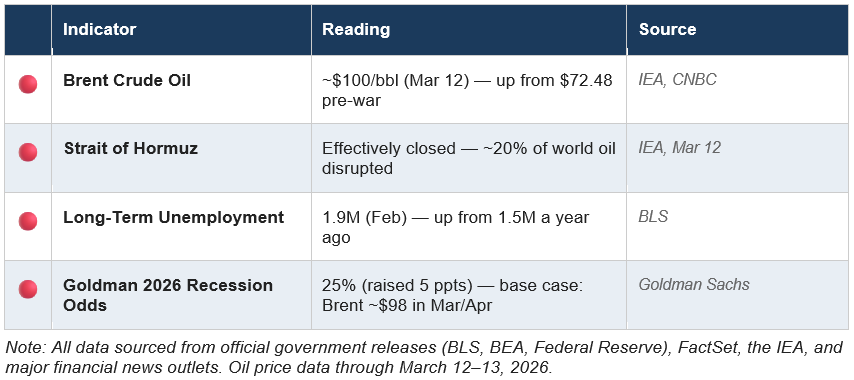
Economic Indicator Dashboard — March 2026
The table below summarizes the key indicators we track and their current readings. Green (✅) means the data is constructive; yellow (⚠️) means we're watching closely; red (⭕) means it represents a near-term risk.
If you would like to discuss how these developments relate to your portfolio — your exposure to equities, bonds, cash, or alternative assets — please do not hesitate to contact us. Your monthly performance report is posted to your client portal at fortemfin.com. We are always happy to speak with you or anyone you believe might benefit from thoughtful, data-driven financial guidance.
We will be watching developments in the Middle East and the economic data closely, and will communicate any material changes in our assessment as they emerge.
Additional Data Sources for This Commentary:
Bureau of Labor Statistics — Employment Situation, February 2026 (Mar 6, 2026) | BLS — Consumer Price Index, February 2026 (Mar 11, 2026) | Bureau of Economic Analysis — GDP Second Estimate, Q4 2025 (Mar 13, 2026) | IEA Monthly Oil Market Report (Mar 12, 2026) | FactSet Earnings Insight (Mar 12, 2026) | CME FedWatch Tool | S&P Dow Jones Indices | Advisor Perspectives / dshort — February 2026 market data | Carson Group geopolitical events analysis | Goldman Sachs macro scenarios (Mar 11, 2026) | CNBC Markets | CNN Business | Axios Markets | Wikipedia — 2026 Strait of Hormuz crisis.
Sincerely,
Fortem Financial
(760) 206-8500
team@fortemfin.com
