
Summary
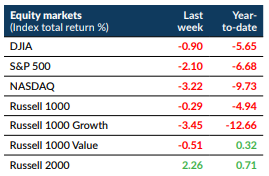
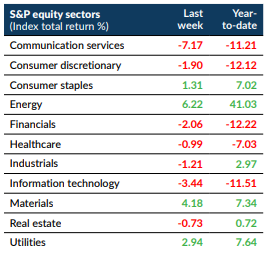
Stocks fell again (S&P 500 -2.10%) (and to the lowest level since September) for the fifth week in a row with NASDAQ down ten of the last eleven weeks. Best sectors were energy (+6.22%), materials (+4.18%), and utilities (+2.94%); worst sectors were communication services (-7.17%) and information technology (-3.44%).
Key Takeaways
- President Trump extended his deadline for a deal with Iran for ten more days. This will likely prolong uncertainty and volatility in the financial markets.
- Mortgage application volumes fell 10.5% in the week ending March 20, extending the prior week's 10.9% decline as the 30-year fixed rate climbed to 6.43%, a five-month high driven by the surge in long-dated Treasury yields.
- The war is currently only four weeks old, but it appears that the significant increase in commodity prices could be more lasting as damage to the region's infrastructure may take years to repair.
- A 2% inflation target is what most developed market central banks aim for, but history keeps delivering shocks that pull inflation higher. Some are "outside" events - wars, comodity disruptions, pandemics. Others are "inside" - bigger monetary and fiscal responses to downturns.
- Investors are largely focused on the shipping status of the Strait of Hormuz (appropriately) but less attention has been paid to the Treasury market. (The U.S. is now facing slower growth, more fiscal spending, and a change in the outlook for Fed policy. The net effect is the Treasury market is pricing in more issuance.)
- Front-end rates have whipsawed as markets struggle to price the energy shock. Short-term rates across developed markets moved sharply over the past few days. Led by the UK, markets priced out remaining cuts for this year and moved to price hikes.
- Recent high-profile private credit strains do not signal broad systemic risk. Private credit's share is modest, banks are easing lending standards amid likely to be lessened capital constraints, bank loan growth is accelerating, bond issuance is strong, and junk bond spreads remain tight.
- The negative oil pillar may be front-of-mind right now, but positive pillars include : fiscal (capex expensing, deregulation, tax refunds, lower tariffs), monetary (lagged effects of -175bp cuts, expanding Fed balance sheet), and productivity.
- Stocks are down about 9% from the highs but importantly the P/E multiple on forward earnings is down by 16%.
- The bull case for stocks is the war in Iran ends, Europe has easy money, Japan has easy money, Kevin Warsh cuts U.S. rates by 200 bps, and it is away to the races.
Source: Bob Doll, CEO, CTO, Crossmark Investments
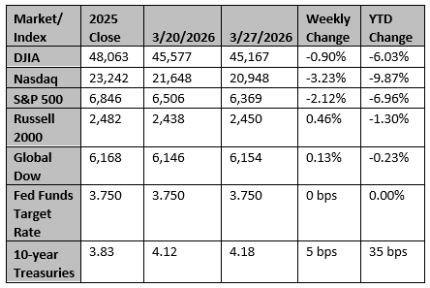
Chart reflects price changes, not total return. Because it does not include dividends or splits, it should not be used to benchmark performance of specific investments. Data provided by Refinitiv.
Sincerely,
Fortem Financial
(760) 206-8500
team@fortemfin.com
Latest News
Global bond prices set for biggest monthly fall in years as Iran war stokes stagflation fears
Global government bond prices were set for their biggest monthly fall in years as investors weighed the risks from a prolonged war in the Middle East on inflation and growth.
Reuters
US food giant Sysco strikes $29 billion deal for catering supplier Restaurant Depot
Sysco said on Monday it would buy catering supplier Jetro Restaurant Depot in a $29 billion deal, including debt, expanding the top U.S. food distributor's reach among price-conscious independent restaurants.
Reuters
