
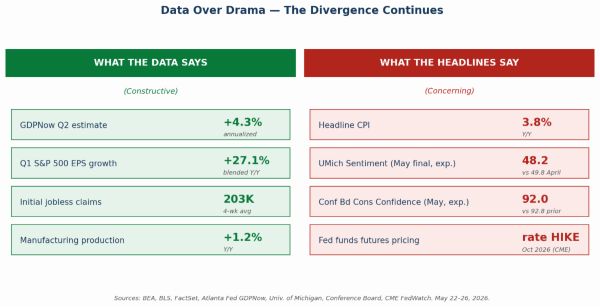
The doom-and-gloom narrative around the U.S. economy is loud, but the data continues to tell a different story. Markets just delivered an eighth consecutive weekly gain, with the S&P 500 closing Friday at 7,473.47, the Dow at a record 50,579.70, and the Nasdaq at 26,343.97.1 The market has, in effect, fully looked through the impact of the war with Iran. As we have said in prior weeks, when the headlines and the data disagree, we follow the data.
The most recent data is, frankly, better than the popular narrative suggests. Real GDP grew at a 2.0% annual rate in Q1, and we believe Q2 is tracking near 3.0%. The Atlanta Fed's GDPNow model is even more optimistic at +4.3%.2 Initial jobless claims have averaged just 203,000 over the past four weeks — lower than three months ago, six months ago, or a year ago. Manufacturing production is up 1.2% from a year ago, against a backdrop where manufacturing fell at a 0.4% annual rate over the ten years ending April 2025.2
Inflation: Hot, but Concentrated
The most uncomfortable read this week is inflation. CPI is up 3.8% from a year ago, well above the Fed's 2.0% target.2 This will likely keep the Fed from cutting short-term rates for at least the next few months. We continue to view the bulk of the move as energy pass-through tied to the U.S.–Iran conflict and the disruption in the Strait of Hormuz rather than a monetary phenomenon. Over time, inflation is a monetary phenomenon, and money supply growth has slowed meaningfully from its COVID-era extremes.2 This is consistent with our framing that current inflation is likely influenced by Iran, not the money supply. The May 22 print of WTI at $96.36 and Brent at $94.82 — down roughly 5.4% on the week as Middle East negotiations advanced — supports that view.1
The Fed Transition and What the Curve Is Saying
Kevin Warsh was sworn in as Federal Reserve Chair on Friday, May 22, marking the end of the Powell era.3 As we noted last week, Mr. Warsh has reportedly suggested a combination of quantitative tightening alongside lower interest rates — a meaningful shift from recent Fed policy. One development worth flagging: with headline CPI and PPI both running hot, the CME Group's FedWatch tool has moved the expected timing of a quarter-point rate hike to October 28, 2026.1 A market pricing in a hike rather than a cut is a notable shift in posture. Our base case remains that headline inflation eases as energy normalizes — but we respect what the curve is saying.
The Consumer: Spending Up, Sentiment Down
The bifurcation between what consumers are doing and what consumers are saying continues to widen. Personal consumption rose 0.9% in March — the strongest monthly gain in some time.4 But the University of Michigan Consumer Sentiment Index, which hit a record-low 49.8 in April, is expected to tick lower again at 48.2 for the May final.3 The Conference Board's Consumer Confidence reading for May is expected at 92.0, down from 92.8 prior.1 Sentiment surveys can lead spending behavior, and we are not dismissing that. But for now the actual spending data — not the sentiment data — is what shows up in earnings. With roughly two-thirds of the S&P 500 reported, Q1 blended EPS growth stands at +27.1% Y/Y — the sixth straight quarter of double-digit earnings growth.4
Our View
The weight of the evidence still points constructive. Earnings are growing, productivity is rising, the labor market remains tight, and capital investment — driven by AI and data center buildout — is accelerating. Headline inflation is uncomfortable, but the composition is consistent with an energy shock that should fade as the Iran situation resolves. Secretary of State Marco Rubio said this week that a deal “could take a few days.”5 We continue to maintain a bias toward quality: companies with durable cash flows, pricing power, and disciplined capital allocation.
Risks We Are Watching
We are not minimizing the risks. A breakdown in U.S.–Iran negotiations would push energy prices back up and stretch the consumer's already-thin savings cushion. A forward P/E of roughly 21x for the S&P 500 is supported by earnings but leaves limited margin for error if Q2 or Q3 disappoints. The Fed transition introduces policy uncertainty markets have not fully priced. And the divergence between spending and sentiment cannot persist indefinitely — one or the other will adjust.
Key Dates Ahead
May 28, 2026 — April PCE Price Index, Q1 GDP second estimate, April durable goods.
June 6, 2026 — May Employment Situation Report.
June 11, 2026 — May CPI.
June 16–17, 2026 — First FOMC meeting under Chair Warsh.

Chart reflects price changes, not total return. Because it does not include dividends or splits, it should not be used to benchmark performance of specific investments. Data provided by Refinitiv.
Sincerely,
Fortem Financial
(760) 206-8500
team@fortemfin.com
Footnotes / Sources
[1] Yahoo Finance, FRED (St. Louis Fed), Seeking Alpha — market data for the week ending May 22, 2026 (S&P 500, Dow, Nasdaq, Russell 2000, WTI, Brent, VIX, gold close prices; CME FedWatch implied rate path).
[2] Brian S. Wesbury and Robert Stein, “Monday Morning Outlook: Not So Bad,” First Trust Portfolios, May 26, 2026. GDP figures sourced from Bureau of Economic Analysis; CPI from Bureau of Labor Statistics; manufacturing production from Federal Reserve G.17; initial claims from Department of Labor.
[3] Reuters, “Morning News Call — USA Edition,” Friday, May 22, 2026.
[4] FactSet Earnings Insight, May 1, 2026 (Q1 2026 S&P 500 blended EPS growth); Bureau of Economic Analysis Personal Income and Outlays, March 2026.
[5] Reuters, “Morning News Call — USA Edition,” Tuesday, May 26, 2026.
Latest News
Exclusive: As Fed leashes bank examiners, Wall Street pushes for more wins, sources say
Wall Street banks are pushing the Federal Reserve behind the scenes to cement its new supervisory regime so the changes cannot easily be reversed by potential future Democratic administrations, said four people with knowledge of the matter.
Reuters
US Supreme Court won't hear Meta's challenge to Vermont social media addiction lawsuit
The justices turned away Meta's appeal of a lower court's ruling that let the lawsuit proceed, rejecting the company's argument that courts in Vermont lack jurisdiction over the dispute.
Reuters
