
A Strong Jobs Report, an AI-Led Selloff, and What the Evidence Actually Says
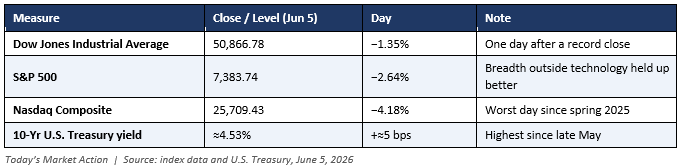
In our June monthly commentary we flagged June 5 as the date to watch for the wage-and-jobs leg of the cycle. It arrived today, and the market’s response pulled two of our running threads into a single, unusually sharp session. The May employment report came in far stronger than expected, Treasury yields jumped, and equities sold off hard — led almost entirely by the artificial-intelligence and semiconductor names that have powered this year’s advance. The Nasdaq Composite fell 4.18% to close at 25,709.43, its worst day since the spring of 2025; the S&P 500 lost 2.64% to 7,383.74; and the Dow gave back 695 points, or 1.35%, to 50,866.78 — one day after setting a record.[1]
Days like today are where our discipline earns its keep. The financial media will frame this as the moment the AI trade “broke.” We would urge a steadier read: weigh the data over the drama. When we take the session apart — the earnings report that triggered it, the jobs number that accelerated it, and the factor data underneath the names that fell — what we find is a repricing of expectations and valuations after a near-vertical run, not a deterioration in the underlying business results. The volatility we said to expect in the June’s monthly commentary has shown up on schedule. Our posture remains constructive and, as always, vigilant.
1. The Tape: A Concentrated, Chip-Led Selloff
The first thing to note is how narrow this was. The 4.18% drop in the Nasdaq against a 1.35% decline in the Dow is the signature of a selloff concentrated in one corner of the market — technology, and semiconductors in particular — rather than a broad flight from risk. Outside of technology, market breadth held up far better; in fact, the Dow closed at a record just one session earlier. Chip indexes took the hardest hit, with the Philadelphia Semiconductor Index off roughly 5%, and the largest chip names falling from mid-single digits to low double digits. By one widely cited estimate, something on the order of $1 trillion of semiconductor-sector market value was in play during the session.[2]
[1] Index closing levels, June 5, 2026 (Nasdaq Composite −4.18% to 25,709.43; S&P 500 −2.64% to 7,383.74; Dow Jones Industrial Average −1.35% to 50,866.78). Source: CNBC; index data.
2. The Catalyst: A Beat Against Guidance, a Miss Against Expectations
The proximate trigger was an earnings report, and it is worth being precise about what it did and did not say — because that distinction is the whole story. After the close on June 3, Broadcom, a bellwether designer of custom AI chips, reported fiscal second-quarter results that beat the company’s own guidance: record revenue, AI-semiconductor revenue above its prior outlook, and record margins. Management guided the current quarter well above year-ago levels and reaffirmed its multi-year target of more than $100 billion in AI-chip revenue for 2027.[3] By the standard of the company’s own forecast, this was a strong quarter and a confident outlook.
What it did not do was clear Wall Street’s elevated bar. Analysts had modeled an AI-revenue figure near $17.2 billion for the coming quarter; the company guided to roughly $16 billion.[4] That gap — a few percentage points below an expectation that had been ratcheted ever higher through a remarkable run in the shares — was enough to send the stock down about 12% and to set off a sympathy selloff across the chip complex. A beat against guidance and a miss against expectations are not the same thing, and conflating them is how a very good quarter becomes a bad day in the market.
We made essentially this point in the with our June commentary: a capital-spending boom tells us how confident management teams are today; it is not a promise about tomorrow’s returns, and the heaviest spenders are not automatically rewarded. When a stock is priced for perfection, “merely very good” can register as a disappointment. That is a statement about valuation and positioning — not about whether the AI build-out is real.
3. The Accelerant: A Hot Jobs Report Reframes the Fed
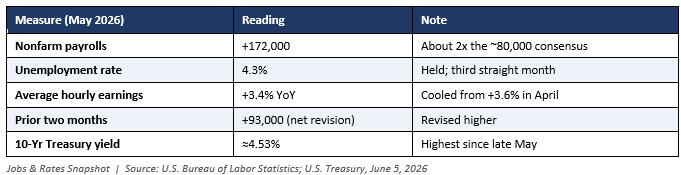
If the earnings reaction lit the match, the May employment report poured on fuel. Employers added 172,000 jobs in May — roughly double the consensus near 80,000 — while the unemployment rate held at 4.3% for a third straight month and the prior two months were revised up by a combined 93,000.[5] On its face that is good news: the “low-hire, low-fire” labor market we described in June’s commentary looks sturdier than some believed. But in the current environment, good news on jobs is awkward news for interest rates. Average hourly earnings rose 3.4% over the past year, a touch cooler than April’s 3.6% — the same real-wage squeeze we have been tracking — yet the headline strength was more than enough to move the bond market.
The 10-year Treasury yield climbed to about 4.53%, its highest in roughly two weeks, and futures markets shifted from debating whether the Federal Reserve would stay on hold to pricing a quarter-point rate increase by year-end as the base case.[6] That is a meaningful evolution of the picture we drew in the June’s commentary, where the near-term debate had already moved from “when does the Fed cut” to “does it stay on hold.” Higher long-term yields weigh most heavily on the richly valued, long-duration growth stocks that have led the market — which is the mechanical reason the AI and chip names, not the broad index, bore the brunt of today’s move. One caveat worth keeping in view: several economists attributed part of May’s hiring surge to staffing ahead of the World Cup, which begins June 11 — a reminder not to over-read a single month.
[3] Broadcom Inc. fiscal Q2 2026 results and Q3 guidance, reported June 3, 2026 (company press release and earnings call). Wall Street consensus figures per financial press. [5] U.S. Bureau of Labor Statistics, “The Employment Situation — May 2026,” released June 5, 2026. Consensus estimate per Dow Jones. [6] U.S. Treasury yields and federal-funds futures pricing, June 5, 2026 (CME FedWatch Tool; CNBC).
4. Follow the Capital: The Financing Question Comes Into View
Our June monthly commentary was titled Follow the Capital, and today the capital story moved to the foreground in a new way. The scale of AI infrastructure spending has grown so large that even the most cash-rich technology companies are now turning to public markets to fund it. Within the past week, Alphabet raised roughly $80 billion of equity — including a $10 billion investment from Berkshire Hathaway — to finance its build-out, and Meta is reported to be weighing a multibillion-dollar stock sale of its own against capital-spending plans approaching $145 billion this year; Meta characterized that report as speculative.[7] When companies that generate enormous cash flow choose to issue equity to fund spending, it signals how large these commitments have become — and it invites precisely the question we raised in June’s commentary: are the returns on this capital arriving fast enough to justify the outlay? Today the market began to ask that question out loud. We read this as healthy scrutiny of a genuine investment cycle, not a verdict against it. As we wrote, the discipline of capital allocation — quality, not merely quantity — is what separates the winners, and it is why we focus more on which companies are spending, and how well, than on the aggregate dollars.
5. The Global Read: Concentration Cuts Both Ways
The selling did not stay in the United States. Overnight, South Korea’s Kospi fell 5.54% — a steeper drop than other major Asian markets — with index heavyweights Samsung Electronics and SK Hynix down 6.4% and 9.9% respectively.[8] The reason is instructive: those two chipmakers make up more than half of that index, and a large share of its gains this year came from them alone. The same concentration that magnified the advance magnified the decline. It is a clean illustration of a risk that applies wherever leadership narrows to a handful of AI-linked names — when the leaders stumble, there is little else to cushion the index. Notably, local analysts largely described the move as profit-taking rather than the start of a sustained downturn, a read consistent with our own.
6. Our View: The Weight of the Evidence
Step back from the tape, and the weight of the evidence has not shifted nearly as much as the price action suggests. Three things stand out.
First, the business results underneath today’s selloff did not deteriorate — expectations did. The clearest example, Broadcom, beat its own guidance and reaffirmed its long-term targets. The factor data we monitor across the semiconductor group tells the same story: over the past month, the measures of quality, profitability, momentum, and credit we track held up or improved even as prices fell, with the softening concentrated narrowly in analysts’ near-term revision estimates on the single name that missed the elevated bar — not in a broad deterioration of fundamentals.
Second, the macro backbone the June commentary described remains in place. Corporate profits were up roughly 12% from a year ago with margins near records, business investment is in a genuine upcycle, and the most recent earnings season was among the strongest in years.[9] A strong jobs report — even one that complicates the rate outlook — is not the stuff of which downturns are made.
Third, what changed today was the price of money and the price of expectations, not the trajectory of the economy. Higher yields compress the multiples investors will pay for future growth, and a vertical run had pushed the most popular names to valuations that left no room for anything short of perfection. A reset of that kind, however uncomfortable, is the market doing its job.
On balance, the weight of the evidence still describes an expansion that is maturing, not ending — and a leadership group whose fundamentals, for now, remain intact even after a hard day. We are not dismissing the move, and we are not predicting a smooth path. We expect more volatility as investors keep testing how far this run can go. We view that volatility as the toll for being invested, not a detour off the road. Constructive, but vigilant.
Risks We Are Watching
- The rate path. A genuinely hot labor market that keeps a Fed rate increase in play would sustain upward pressure on yields and downward pressure on high-multiple growth stocks. The June 10 CPI report and the June 16–17 FOMC meeting are the near-term tests.
- AI capital-spending returns. The financing question raised today is real. If revenue growth does not keep pace with the build-out, the market will continue to reprice the most aggressive spenders. We weigh capital discipline heavily in deciding what to own.
- Concentration and correlation. Leadership has narrowed to a small group of AI-linked names. As today’s U.S. session and the overnight move in Korea showed, that concentration amplifies declines as readily as it amplified the gains.
- Policy and geopolitics. Energy prices tied to the Iran and Strait of Hormuz situation, and trade and export-control developments affecting semiconductors, remain swing factors we continue to monitor.
Key Dates to Watch
- June 10: May Consumer Price Index — the first read on whether the energy-driven inflation we described is still pushing the headline.
- June 16–17: FOMC meeting, updated economic projections, the dot plot, and the Chair’s press conference — the most important event on the near-term calendar after today.
- June 25: Q1 GDP (third estimate) and the third look at corporate profits.
- Late June: May PCE Price Index — the Federal Reserve’s preferred inflation gauge.
Days like today can be unsettling, and we would rather you hear our read than the headlines’. If you would like to discuss your portfolio, or what today’s move means in the context of your plan, please don’t hesitate to contact us by phone or email and we will arrange a suitable time. Your reports remain available on your client portal at fortemfin.com. And if you know someone who would benefit from a steady, data-driven approach in a noisy market, we would be glad to help.
[7] Alphabet Inc. and Meta Platforms, Inc. equity-financing reports, June 1–5, 2026 (company disclosures; Financial Times; Reuters). [8] Asian equity market levels, June 5, 2026 (Korea Exchange; CNBC). [9] Corporate profits and margins per U.S. Bureau of Economic Analysis, as referenced in our June 2026 Monthly Commentary; earnings-season strength per FactSet (confirm at distribution).
Sincerely,
Fortem Financial
(760) 206-8500
team@fortemfin.com
Important Disclosures
Any securities, issuers, or indices identified in this commentary are referenced for illustrative and contextual purposes only, to discuss recent market events, and do not constitute a recommendation to buy, sell, or hold any security or to adopt any investment strategy. Fortem Financial or its clients may hold positions in securities mentioned. This represents our current view and is subject to change without notice. Actual results may differ materially. All statements and opinions included are subject to change as economic and market conditions dictate, and do not necessarily represent the views of Fortem Financial or any of their respective affiliates. Past performance may not be indicative of future results and there can be no assurance that any views, outlooks, projections or forward-looking statements will come to pass. Investing involves risk, including the potential loss of principal, and the profitability of any particular investment strategy or product cannot be guaranteed. Figures and tables in this commentary reflect price changes, not total return; because they do not include dividends or splits, they should not be used to benchmark the performance of specific investments. Past performance is not indicative of future results. Fortem Financial Group is an SEC-registered investment adviser and a licensed insurance agency. Registration does not imply a certain level of skill or training. Sources: U.S. Bureau of Labor Statistics; U.S. Bureau of Economic Analysis; Federal Reserve Board and CME FedWatch; company disclosures and financial press; index data. Market data as of the close on June 5, 2026.
