
Loud Headlines, Intact Fundamentals
It was a loud few days. On Friday, the Nasdaq Composite fell 4.18% — its worst single day since April 2025 — as a violent selloff in semiconductor and AI-related shares dragged the major indexes lower, with the Philadelphia Semiconductor Index down 10.26%, its steepest drop since March 2020. Over the weekend, the conflict in the Middle East escalated again, and South Korea’s market, heavily concentrated in memory chips, opened sharply lower to start the week. (Sources: Nasdaq, FactSet; CNBC; Korea Exchange.)
The headlines are real, and we do not dismiss them. But headlines and fundamentals are not the same thing. When we look past the price action to what companies actually reported and what the structural data actually shows, the picture is far less alarming than the tape suggests. The market’s mood can swing hard in a few days; the fundamentals underneath move far more slowly — and right now, they have not deteriorated.
Our conclusion up front: Friday’s selloff was a repricing of expectations and crowded positioning in a richly valued group of stocks — not evidence that the businesses underneath are weakening. And the oil disruption tied to the Strait of Hormuz, while serious, is being engineered around in real time. In both cases, what moved was sentiment and price — not the fundamentals underneath.
1. A Selloff Without a Story
The names that fell hardest on Friday were the market’s AI and semiconductor leaders. The narrative blamed Broadcom’s earnings, reported after the close on June 3rd. So it is worth looking at what Broadcom (AVGO) actually said.
Broadcom beat and raised. The company reported record fiscal Q2 2026 revenue of $22.2 billion, up 48% year-over-year, with AI semiconductor revenue of $10.8 billion, up 143% and above its own forecast. It then guided third-quarter revenue higher, to roughly $29.4 billion (up 84% year-over-year), including $16.0 billion of AI semiconductor revenue (up more than 200%), and reaffirmed an expectation of more than $100 billion in AI revenue in fiscal 2027. Its chief executive described demand as “insatiable.” (Source: Broadcom Form 8-K and earnings release, June 3, 2026.)
This is the key point: Broadcom did not miss its numbers. It beat them, and it raised guidance. What it “missed” was a level of expectation that some analysts had attached to the stock — numbers the company itself never set — after an extraordinary run higher. A stock can fall on a great quarter when it was priced for a perfect one. That is a statement about positioning and valuation, not about the business.
The contrast is even sharper for the others. The stocks that fell most on Friday — Marvell, Micron, and AMD — did not report anything on Friday at all. They fell in sympathy. And their most recent reported results were each a beat accompanied by raised guidance:
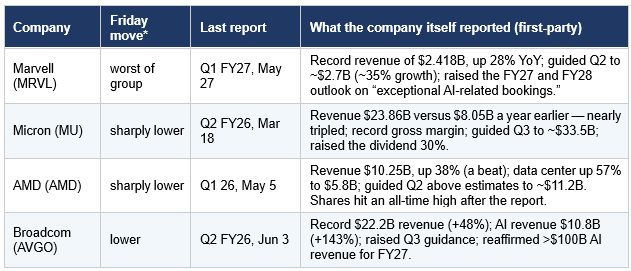
Sources: company earnings releases and SEC filings (AVGO, MRVL, MU, AMD). *Intraday percentage moves on June 5 varied widely by data feed and time of day; figures here are directional. Reflects price changes, not total return.
So what changed on Friday? Not the reported fundamentals — those were strong and, in several cases, only days old. What changed was sentiment in a group that had become very crowded and very expensive. For perspective, even after the selloff, the iShares Semiconductor ETF was still up roughly 79% on the year. (Source: provider data.) A pullback in a group that had risen that far, that fast, is more consistent with a position-trimming reset than with the beginning of a fundamental decline. A selloff without a deteriorating-earnings story behind it is, in our view, exactly that: a selloff without a story.
2. The Strait of Hormuz: Serious, but Bounded
The weekend’s second headline was the renewed conflict in the Middle East and the continued disruption to oil shipments through the Strait of Hormuz, the waterway that normally carries roughly 20 million barrels per day of crude and petroleum products — about one-fifth of global consumption. (Source: U.S. Energy Information Administration.) Oil has been elevated and volatile as a result. This is a genuine disruption, and we are watching it closely. But three facts argue strongly that it is a bounded, time-limited shock rather than an open-ended crisis.
First, the world entered this disruption with an unusually large cushion — though it is worth being precise about how much of it is actually usable. The International Energy Agency assesses total observed global oil inventories at more than 8.2 billion barrels, the highest level since February 2021. (Source: IEA Oil Market Report, March 2026.) But most of that total is working oil that cannot simply be drawn down — crude and products in transit on water, pipeline fill, and the minimum operating levels refineries and tanks must hold to keep running.
The stocks held specifically for release in a supply emergency are a smaller but still very large layer: IEA member governments hold more than 1.2 billion barrels of public emergency reserves plus roughly 600 million barrels of industry stocks under government obligation, and China holds the world’s largest strategic inventory at roughly 1.5 billion barrels. (Sources: IEA; U.S. Energy Information Administration, 2026.) Together that is on the order of 3 billion barrels of deployable reserves sitting on top of ordinary commercial inventories — and it is already being used: on March 11, 2026, the IEA authorized a coordinated release of 400 million barrels, the largest in its history, and the United States has drawn from its roughly 400-million-barrel Strategic Petroleum Reserve. (Sources: IEA; EIA, 2026.)
How long does that buffer last against the draw? The EIA expects global inventories to fall by an average of about 8.5 million barrels per day in the second quarter of 2026 — its peak-quarter estimate, as shut-in production tops out — easing to an average of roughly 2.6 million barrels per day across 2026 as a whole. (Source: EIA Short-Term Energy Outlook, May 2026.) Even at the steeper second-quarter pace, roughly 3 billion barrels of deployable reserves is on the order of a year of cover; at the full-year rate it stretches considerably further. And it does not have to last indefinitely: the EIA expects Strait of Hormuz shipments to move back toward pre-conflict levels later in 2026 and into 2027 as production recovers and bypass capacity comes online — the reason it projects crude easing to roughly $79 per barrel in 2027. (Source: EIA Short-Term Energy Outlook, May 2026.) The buffer’s job is to bridge the gap until replacement supply arrives, not to replace Gulf oil indefinitely.
Second, the infrastructure to route oil around the Strait is large and being built out rapidly. This is the part of the story the headlines tend to miss. Producers are not passively waiting; they are actively re-plumbing global oil flows:
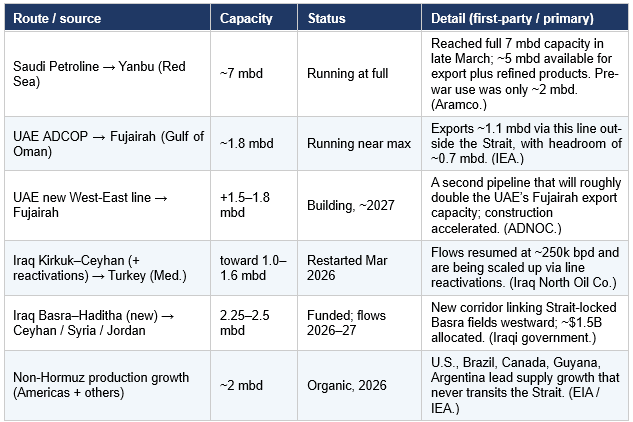
Sources: U.S. Energy Information Administration; International Energy Agency; Saudi Aramco; ADNOC; Iraqi government statements. Capacities reflect a mix of in-use, under-construction, and proposed routes; realization is phased over the next 12–24 months.
Because that capacity arrives in stages over the next year and beyond, the daily shortfall should shrink as it comes online — which means the inventory cushion lasts longer than a simple static calculation implies. A buffer drawn against a shrinking gap stretches further than a buffer drawn against a fixed one. We would also note that this build-out is permanent: each new pipeline and terminal structurally reduces the world’s dependence on the Strait, regardless of how the conflict resolves.

Figure 1. Global oil inventories and the build-out of non-Hormuz delivery capacity. Drawdown paths are illustrative scenarios, not forecasts. | Sources: U.S. Energy Information Administration; International Energy Agency.
Third, demand adjusts and the global economy keeps functioning. At higher prices, consumption moderates — the EIA has already reduced its 2026 global oil demand growth estimate to roughly +0.2 million barrels per day, down from over a million earlier in the year. (Source: EIA Short-Term Energy Outlook.) Just as important, the world has been living with this conflict since late February, and global equity markets have processed it rather than collapsed under it. The economic and energy systems have repeatedly demonstrated the capacity to adapt to geopolitical shocks and continue functioning — and the increasing alignment of the Gulf producers against the disruption, alongside a significant military and economic imbalance among the parties, makes a permanent, open-ended closure less probable than the headlines imply.
We are not waving away the risks. The relief we describe arrives in tranches over many months, not overnight; strategic reserves are being actively drawn (the U.S. Strategic Petroleum Reserve has fallen to roughly 357 million barrels, its lowest since January 2024); the Red Sea shipping route carries its own security risk; and the path of the conflict itself is the genuine uncertainty here, one we hold with humility rather than false confidence. Oil prices are elevated and may stay volatile. But “elevated and volatile for a while” is a very different proposition from “permanent structural shortage,” and the supply picture we just walked through — the inventories and the build-out — is what separates the two. (Source: U.S. Department of Energy.)
3. What Hasn’t Changed
Step back from the two loud stories, and the constructive backdrop that was in place at the start of this month is still in place. Corporate earnings have been strong — the very AI and semiconductor companies at the center of Friday’s selloff posted record results and raised their guidance. The most recent labor report showed nonfarm payrolls rising by 172,000 in May, ahead of expectations. (Source: Bureau of Labor Statistics.) And the productivity, capital-expenditure, and consumer-spending picture we have written about in prior commentaries has not reversed.
None of that changed on Friday. Prices changed. Fundamentals did not. That distinction is the entire point. Markets are a mechanism for processing uncertainty in real time, and processing is often noisy — a series of fits and starts, sharp drops, and sharp recoveries. We have seen this pattern many times: investors who let a few violent sessions override the longer-term evidence have consistently left returns on the table. The economy has a long history of continuing to function through geopolitical conflict and market volatility alike, and we see no evidence in the data that this time is different.
4. Our View: The Weight of the Evidence
When we weigh the evidence, volatility is not the same as deterioration. Friday’s selloff reflected stretched positioning and expectations in a crowded group, not weakening business fundamentals — the companies involved reported strong numbers and raised guidance. The oil disruption is serious, but the combination of record starting inventories, a large and accelerating build-out of routes around the Strait of Hormuz, demand that moderates at higher prices, and an economy that keeps functioning argues for a bounded shock rather than an open-ended crisis.
We remain constructive, and we are watching the genuine risks: the path of the conflict and the price of oil, and a Federal Reserve navigating still-elevated inflation. Those warrant vigilance, not alarm. As we have written before, volatility is the price of admission to equity markets — it is not, by itself, a signal that the underlying fundamentals have changed. Right now, by the measures we follow most closely, they have not.
Key Dates to Watch
June 9: EIA Short-Term Energy Outlook — a refreshed read on the global supply balance, inventory draw, and U.S. production outlook.
Mid-June: May Consumer Price Index (BLS) — the next major inflation reading, and an input to the Fed’s rate path.
June 16–17: Federal Reserve FOMC meeting — the first under the new Chair; current target rate is 3.50%–3.75%.
Ongoing: Strait of Hormuz developments and the pace at which bypass pipeline and port capacity comes online.
Sincerely,
Fortem Financial
(760) 206-8500
team@fortemfin.com
Important Disclosures
Fortem Financial Group is an SEC-registered investment adviser. Registration does not imply a certain level of skill or training. This commentary is provided for informational and educational purposes only and does not constitute investment, legal, or tax advice, an offer or solicitation, or a recommendation to buy or sell any security. It does not take into account the specific objectives, financial situation, or needs of any individual. Specific securities are referenced solely to illustrate market conditions and are not recommendations. Fortem Financial and its clients may hold positions in the securities mentioned. Any reference to a specific security should not be construed as a recommendation to buy, hold, or sell that security. Forward-looking statements: This represents our current view and is subject to change without notice. Actual results may differ materially. There can be no assurance that any views, outlooks, projections, or forward-looking statements will come to pass. Past performance is not indicative of future results. References to index or security price movements reflect price changes, not total return, and do not include dividends or splits. All statements and opinions included are subject to change as economic and market conditions dictate, and do not necessarily represent the views of Fortem Financial or any of their respective affiliates. Past performance may not be indicative of future results and there can be no assurance that any views, outlooks, projections or forward-looking statements will come to pass. Investing involves risk, including the potential loss of principal, and the profitability of any particular investment strategy or product cannot be guaranteed.
