
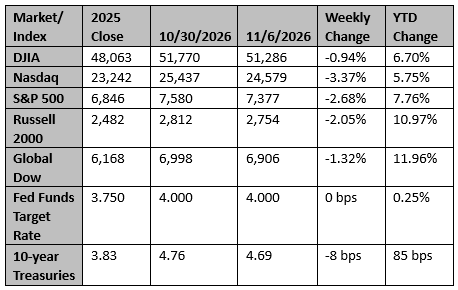
Markets reacted sharply to last Tuesday's midterm results. On Thursday, U.S. stocks lost $3.2 trillion in value and chip stocks fell 12%, their second-largest decline on record. Reuters attributed the drop to concern that a Democratic-controlled Congress could slow the buildout of AI data centers.[1] Before Thursday, the S&P 500's largest pullback this year was 9%. JPMorgan puts the typical midterm-year pullback at 18% to 19%, so this year's was about half that.[2] Even after the selloff, the index was about 5% below its all-time high.[1]
The policy record gives useful context. The CHIPS and Science Act, which provides federal aid for domestic semiconductor manufacturing, passed in 2022 by votes of 64-33 in the Senate and 243-187 in the House.[3] Support for U.S. chip capacity has not belonged to one party. How the new Congress will handle data-center permitting and power is not yet known. We will judge it by legislation and agency action, not campaign rhetoric.
Demand for AI infrastructure continues to show up in company results. Alphabet said sales of its in-house AI chips contributed meaningfully to the September quarter, when Google Cloud revenue more than doubled to $30.71 billion.[4] On Monday, Alphabet introduced two new chip variants:
- The 8tx is built for government and regulated industries. It pairs Google's chips with AMD processors and encrypts data at the hardware level, and Google says it is up to twice as fast as the prior version.
- The 8i Max combines two chips in one package for memory-intensive work.
Alphabet shares rose more than 3% in early trading.[4]
The October jobs report was strong:
- Nonfarm payrolls rose 165,000, well above the 70,000 consensus. Upward revisions of 84,000 to prior months brought the net gain to 249,000.[5]
- Private payrolls rose 159,000. The leaders were professional and business services (+70,000), healthcare and social assistance (+55,000), and transportation and warehousing (+25,000). Manufacturing added 19,000.[5]
- Civilian employment rose 463,000, and the labor force grew by 421,000.[5]
- The unemployment rate fell to 4.1% from 4.2%, although the unrounded change was small: 4.141% versus 4.175%.[5]
Other labor and productivity data point the same way:
- Average hourly earnings rose 0.4% in October and are up 3.1% from a year ago.[5]
- Nonfarm productivity grew at a 3.6% annual rate in the third quarter and is up 2.1% year over year.[5]
- Unit labor costs fell at a 0.7% rate in the quarter. When output grows faster than labor costs, wages put less pressure on inflation.[5]
- Initial jobless claims fell to 189,000. The four-week average of 189,000 is the lowest since 1969.[5]
History offers context, not a guarantee. Since World War II, the S&P 500 has risen in 71% of calendar years, with a median gain of 11.6%.[6] In the 12 months after a midterm election, from 1946 through 2022, it rose every time, with a median gain of 13.7%.[6] Truist's Keith Lerner notes two related points:
- Midterm years themselves have averaged gains of only 8.4% since 1949.
- The economy has not been in recession during the third year of a presidential term since 1950, and the S&P 500 has averaged 20.9% in those years.[7]
The risks deserve equal attention. The Fed raised rates by a quarter point in September, and markets expect another half point next year.[1] That would be 75 basis points in total. By comparison, the Chicago Fed puts the average tightening cycle since 1954 at 400 basis points over 23 months.[8] Inflation has been above the Fed's target for nearly six years.[1] Market leadership is also highly concentrated in a small group of technology companies, so a few earnings disappointments can move the major indices.[1]
There is a partial offset. First Trust notes that wage growth is lagging consumer inflation, which could give the Fed room to raise rates less than markets now expect.[5]
Our view is that the weight of the evidence remains bullish. Hiring, productivity, and AI investment data are all firm. We read last week's selloff as a reaction to policy uncertainty, not a change in the underlying data.
Footnotes
1. Jamie McGeever, "US stocks always rise after midterms. Is this time different?," Reuters (opinion column), November 7, 2026.
2. JPMorgan, as cited in McGeever, Reuters, November 7, 2026.
3. National Governors Association, "The CHIPS and Science Act of 2022" (P.L. 117-167).
4. Anhata Rooprai, "Google unveils new AI chip variants as cloud demand surges," Reuters, November 9, 2026.
5. Bureau of Labor Statistics, Employment Situation and Productivity and Costs releases; Robert Stein and Brian S. Wesbury, "October Employment Report," First Trust Advisors.
6. Deutsche Bank, as cited in McGeever, Reuters, November 7, 2026.
7. Keith Lerner, Truist Wealth Advisory, as cited in McGeever, Reuters, November 7, 2026.
8. Federal Reserve Bank of Chicago, as cited in McGeever, Reuters, November 7, 2026.
Sincerely,
Fortem Financial
(760) 206-8500
team@fortemfin.com
Latest News
China extends US trade truce by two months
China on Monday effectively extended its trade truce with the US by two months, after announcing it would continue to suspend certain trade measures.
Reuters
US Congress gets first post-'Blue Wave' crack at data centers with permitting bill
A sweeping bipartisan energy bill has unexpectedly emerged as the US Congress' first test of how to tackle public anger over data centers and rising electricity costs, which helped to power Democrats to a landslide election victory last week.
Reuters
