
Last week’s headlines centered on a hawkish turn in rate expectations, a leadership change at the largest AI chipmaker, and soft data out of Asia. Beneath the noise, the U.S. data remain firm, and the next real test of the AI build-out arrives tomorrow.
Last week we noted that this Fed tightening cycle has been modest by historical standards. That is changing. Core consumer prices rose more than expected in October for the third straight month as high energy costs passed through to core goods and services.[1] The 10-year Treasury yield is back above 5%, and the 2-year yield rose 35 basis points last week.[2] Fed Governor Christopher Waller has said a 50-basis-point hike should be considered at the December 8-9th meeting.[3]
The economy underneath remains healthy. Unemployment was 4.1% in October,[4] and third-quarter GDP grew at a 3.4% annualized pace in the advance estimate.[5] A tighter Fed is the main risk to our view, but it is happening against a strong economy, not a weakening one.
That backdrop matters for the week’s biggest corporate story. Nvidia CEO Jensen Huang resigned on November 12th, and the board named CFO Colette Kress interim CEO. The shares fell 10% in premarket trading.[6] A leadership change is a governance event, not a change in demand. On November 6th we wrote that the central question for AI is cash timing and whether profits keep pace with spending, and that we would tell you if the data change. Tomorrow’s report is the next data point.
After the close on November 17th, Nvidia reports its fiscal third-quarter results.[7] In August, the company guided revenue to $108.0 billion, plus or minus 2%, with gross margins of about 74%. That guidance assumed no data center compute revenue from China.[8] For comparison, second-quarter revenue was $96.2 billion, and data center revenue rose 117% from a year earlier to $89.0 billion.[8] Analysts expect slightly more than guidance: $109.3 billion of revenue, including $101.8 billion from data centers.[9]
Two different bars matter. A result that beats the company’s own guidance but falls short of analyst estimates is a miss on expectations, not a miss on the business. We will be watching four things:
- Data center revenue against the $101.8 billion estimate, the clearest single read on AI demand.
- Gross margin against the 74% guide, a test of whether pricing power is holding.
- The fourth-quarter outlook, which shows whether demand is still accelerating.
- Interim leadership’s commentary on customer demand and the transition.
Higher rates are not only a U.S. story, and neither is the AI build-out. In September, both the Fed and the Bank of Japan raised rates, lifting Japan’s policy rate to 1.25%, its highest since 1995.[10] Japan’s latest data show the cost of that inflation fight. The economy contracted at a 0.1% annualized rate in the third quarter, against expectations for 0.3% growth, as higher living costs pushed private consumption down 0.3%. Business investment rose 1.6%, led by labor-saving and AI-related projects. Economists quoted by Reuters do not expect the weak quarter to derail the Bank of Japan’s tightening, and many expect its next hike as soon as December.[11]
China shows the same split. AI-driven exports have carried its economy this year, and third-quarter growth of 4.5% landed at the low end of Beijing’s 4.5% to 5% target.[12] October, however, missed on nearly every measure. Industrial output rose 4.8% from a year earlier, versus 5.3% expected. Retail sales rose just 0.4%, versus 0.8% expected, despite a weeklong holiday and the Singles Day shopping festival. Fixed-asset investment fell 8.1% in the first ten months, worse than forecast.[13] The common thread across Asia is that AI-related investment and exports are sustaining growth, while households struggle with higher prices and, in China, a prolonged property slump.
This environment has also tested traditional safe havens. When the threat is inflation rather than recession, Treasuries can fall alongside stocks. That is what happened after the Iran war began on February 28th, when oil jumped, and bond yields rose. Duke University’s Campbell Harvey notes that stocks and Treasuries have increasingly moved in tandem, and that the diversification benefit of the benchmark 60/40 portfolio has declined.[14] Gold has not filled the gap. It fell to a one-year low alongside stocks in late October, and Standard Chartered’s Suki Cooper notes that investors often sell gold to meet margin calls during sharp equity pullbacks.[15] Harvey’s conclusion is that no single asset has proven a dependable all-weather hedge. Gold, Treasuries, inflation-protected Treasuries, commodities and certain active strategies each have a role, but they work best in combination.[15] We agree with the principle. When old relationships between asset classes are less reliable, diversifying across sources of return that respond differently to inflation, growth, and policy becomes more important.
The weight of the evidence remains bullish. Hiring is solid, growth accelerated last quarter, and, as we detailed on November 6th, the AI build-out is backed by signed contracts and rising operating profit. What has changed is the direction of central banks, here and abroad. Inflation is running hot enough that the path of rates is now steeper than it looked a week ago, and a steeper path raises borrowing costs across the economy. We are watching it closely. Tomorrow’s Nvidia report and next month’s Fed meeting will tell us more than the headlines will.
Dates we are watching over the next four weeks:[16]
November 17th: Nvidia third-quarter fiscal 2027 results, after the close.
November 18th: FOMC minutes from the October 27-28th meeting.
November 25th: Second estimate of third-quarter GDP.
December 8-9th: FOMC meeting.
December 10th: November Consumer Price Index.
Footnotes:
1 . U.S. Bureau of Labor Statistics, Consumer Price Index - October 2026, released November 10, 2026. The third consecutive month above forecasts is per Jamie McGeever, “Fed Chair Warsh’s true test begins now,” Reuters (opinion column), November 16, 2026.
2 . McGeever, Reuters, November 16, 2026.
3 . Federal Reserve Governor Christopher J. Waller, speech at the Bank of England Watchers Conference, London, November 10, 2026.
4 . U.S. Bureau of Labor Statistics, The Employment Situation - October 2026, released November 6, 2026.
5 . U.S. Bureau of Economic Analysis, GDP (Advance Estimate), 3rd Quarter 2026, released October 29, 2026.
6 . NVIDIA Corporation, Form 8-K, “NVIDIA Announces CEO Transition,” November 12, 2026. The share move is per the Associated Press, November 12, 2026.
7 . NVIDIA Corporation, “NVIDIA Sets Conference Call for Third-Quarter Financial Results,” October 28, 2026.
8 . NVIDIA Corporation, “NVIDIA Announces Financial Results for Second Quarter Fiscal 2027,” August 26, 2026.
9 . Visible Alpha consensus, as published by S&P Global Market Intelligence, “Nvidia earnings preview,” November 12, 2026.
10 . Bank of Japan, Statement on Monetary Policy, September 18, 2026; Reuters, “Bank of Japan raises interest rates to 31-year high,” September 18, 2026. The Fed’s September hike is per McGeever, Reuters, November 16, 2026.
11 . Japan Cabinet Office preliminary GDP, November 16, 2026, via Makiko Yamazaki and Satoshi Sugiyama, “Japan’s economy unexpectedly shrinks as inflation squeezes households,” Reuters, November 16, 2026. The forecast is the Reuters poll median.
12 . China National Bureau of Statistics, third-quarter GDP release, October 19, 2026.
13 . China National Bureau of Statistics, November 16, 2026, via Kevin Yao and Yukun Zhang, “China’s economy falters as factory output, retail sales undershoot expectations,” Reuters, November 16, 2026.
14 . Karen Brettell, “For investors, a truly safe haven is hard to find,” Reuters, November 16, 2026, citing Campbell Harvey of Duke University.
15 . Brettell, Reuters, November 16, 2026, citing Suki Cooper of Standard Chartered and Campbell Harvey. Spot gold reached a one-year low on October 30, 2026.
16 . Federal Reserve Board calendar; U.S. Bureau of Economic Analysis release schedule; U.S. Bureau of Labor Statistics release schedule; NVIDIA Corporation.
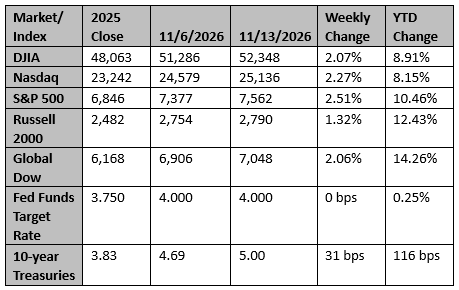
Chart reflects price changes, not total return. Because it does not include dividends or splits, it should not be used to benchmark performance of specific investments. Data provided by Refinitiv.
Sincerely,
Fortem Financial
(760) 206-8500
team@fortemfin.com
Latest News
China's economy falters as factory output, retail sales undershoot expectations
China's economy showed fresh signs of sluggishness in October as factory production slowed and consumption remained weak, calling into question how long the world's second-largest economy can rely on exports to underpin growth.
Reuters
For investors, a truly safe haven is hard to find
When stocks tumbled this month, investors did what they have done for decades and bought US Treasuries and the Japanese yen. But recent selloffs have exposed a growing problem: assets meant to cushion portfolios do not always work when investors need them most.
Reuters
