
In 1852, Karl Marx said "Men make their own history, but they do not make it as they please; they do not make it under circumstances chosen by themselves, but under circumstances directly encountered and transmitted from the past." He obviously knew about the Magna Carta (1215) and the English Parliament’s Bill of Rights (1689), which created a separation of powers between the King and elected representatives. What he didn’t pay much attention to was how the United States broke with history… View More
Authors
Fortem Financial

Post 11 to 20 of 637
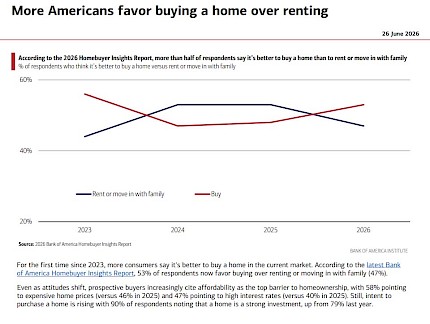
However, it is a bit challenging due to increased regulations and interest rates. This year’s Homebuyer Insights Report survey data reveals meaningful changes in attitudes toward homeownership. The study finds that for the first time since 2023, more Americans favor buying a home (53%) over renting or moving in with family (47%). Even as attitudes shift, prospective buyers increasingly point to affordability as the top barrier to homeownership, with expensive home prices (58%, … View More
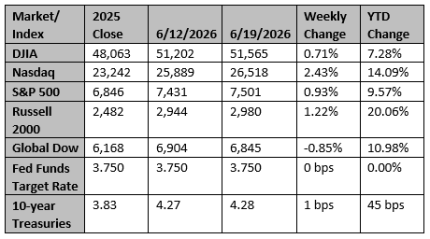
A deal to extend the ceasefire in the Middle East has finally been agreed, allowing energy prices to decline further and risk-asset markets to resume their pre-war bull run. The history of the Middle East points to inevitable bumps ahead. A lasting peace has not been achieved, and some of the players are not agreeing to stop at this juncture. Should investors expect setbacks ahead? Summary Equities were higher last week with the DJIA and Russell 2000 hitting record highs, while the S&P… View More
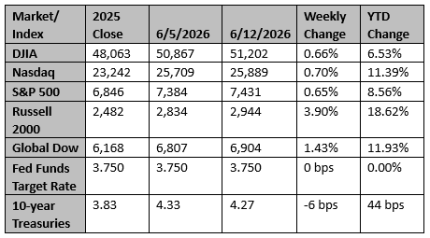
With what appears to be a deal with Iran taking shape and the reopening of the Strait looking increasingly likely, the two most important questions we are asking ourselves are: 1) How will global inflation expectations respond, and 2) will markets revert to the trends and themes that were working before the conflict began? Easing Inflation Expectations to Provide Rate Relief The direction of global inflation expectations will be one of the most important variables to monitor in the coming … View More
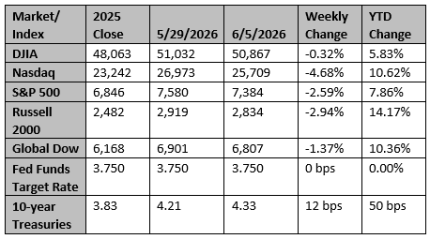
The job market was surprisingly strong in May, with non-farm payrolls growing 172,000, beating even the strongest forecasts for the month. As a result, the futures market is now pricing in a quarter-point rate hike later this year and, more likely than not, another quarter-point rate hike sometime in 2027. But we think a rate hike would be ill-advised and unlikely. First, this is a good employment report, but not a “barnburner.” Barnburner job growth is 300,000 to 400,000 per month. Even Ke… View More
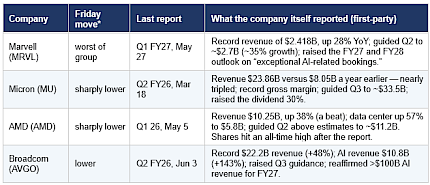
Loud Headlines, Intact Fundamentals It was a loud few days. On Friday, the Nasdaq Composite fell 4.18% — its worst single day since April 2025 — as a violent selloff in semiconductor and AI-related shares dragged the major indexes lower, with the Philadelphia Semiconductor Index down 10.26%, its steepest drop since March 2020. Over the weekend, the conflict in the Middle East escalated again, and South Korea’s market, heavily concentrated in memory chips, opened sharply lower to start… View More
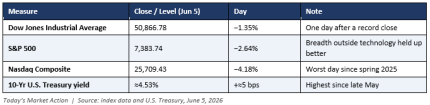
A Strong Jobs Report, an AI-Led Selloff, and What the Evidence Actually Says In our June monthly commentary we flagged June 5 as the date to watch for the wage-and-jobs leg of the cycle. It arrived today, and the market’s response pulled two of our running threads into a single, unusually sharp session. The May employment report came in far stronger than expected, Treasury yields jumped, and equities sold off hard — led almost entirely by the artificial-intelligence and semiconductor na… View More
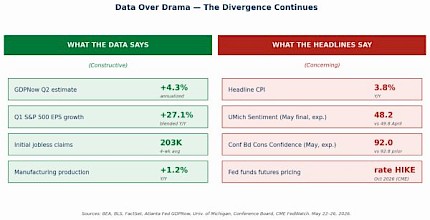
The doom-and-gloom narrative around the U.S. economy is loud, but the data continues to tell a different story. Markets just delivered an eighth consecutive weekly gain, with the S&P 500 closing Friday at 7,473.47, the Dow at a record 50,579.70, and the Nasdaq at 26,343.97.1 The market has, in effect, fully looked through the impact of the war with Iran. As we have said in prior weeks, when the headlines and the data disagree, we follow the data. The most recent data is, frankly, better tha… View More
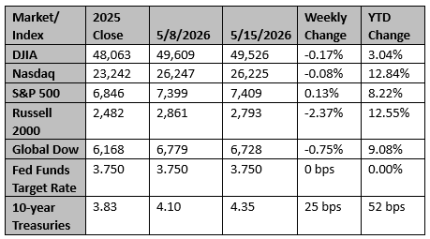
To say the least, since its inception in 1913, the Federal Reserve has had its ups and downs. One thing most people don’t know is that, prior to the invention of the Fed, other than during wars, there was almost no inflation. Various sources , including the Federal Reserve regional banks, show that the purchasing power of $1 in 1900 was the same as or higher than it was in 1800. The Government did print and borrow money during wartime, which caused inflation during the War of 1812 and the Civ… View More
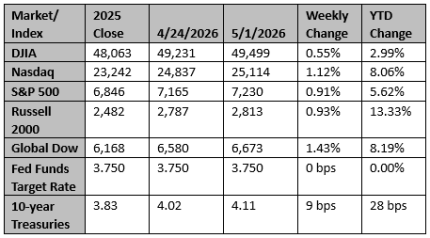
With roughly 60% of S&P 500 companies having reported, earnings growth estimates have climbed to 27.8%—nearly double the 14.4% expected at the start of the quarter. While mega-cap companies have delivered particularly strong results, growth expectations have improved across every sector except energy. This marks the sixth consecutive quarter of double-digit earnings growth. Equally notable, revenue growth is now exceeding 10%, with broad-based strength across sectors. 2026 full-year earni… View More